If you've ever tried to hire a mold company in New York and gotten confused answers about who does what — this is why. NY Labor Law Article 32, effective January 2015, separated mold work into three licensed roles: assessor, remediation contractor, and remediation worker. Each has its own credential. And one rule matters more than any other: the same licensee cannot perform both the assessment and the remediation on the same property.
The three licensed roles
- Mold Assessor (MA) — writes the scope, identifies mold, measures affected area, documents cause. Cannot perform the cleanup.
- Mold Remediation Contractor (MR) — executes the removal per IICRC S520 or industry-equivalent protocol. Cannot write the assessment for the same job.
- Mold Remediation Worker (MW) — technicians working under an MR-licensed supervisor.
Before 2015, one company handled all of it — and had an obvious financial incentive to scope big. The conflict was so common that NY's Department of Labor wrote the walled-arm requirement specifically to eliminate it.
When does the assessor requirement kick in?
For any mold project affecting more than 10 square feet, NY law requires an independent MA-licensed assessment before remediation begins. Below that threshold — a small bathroom corner, a single wall cavity — the homeowner can engage a remediator directly. Above it, the assessor is mandatory.
What an assessor's scope actually includes
- Visual inspection and mold identification (species hypothesis, often lab-confirmed)
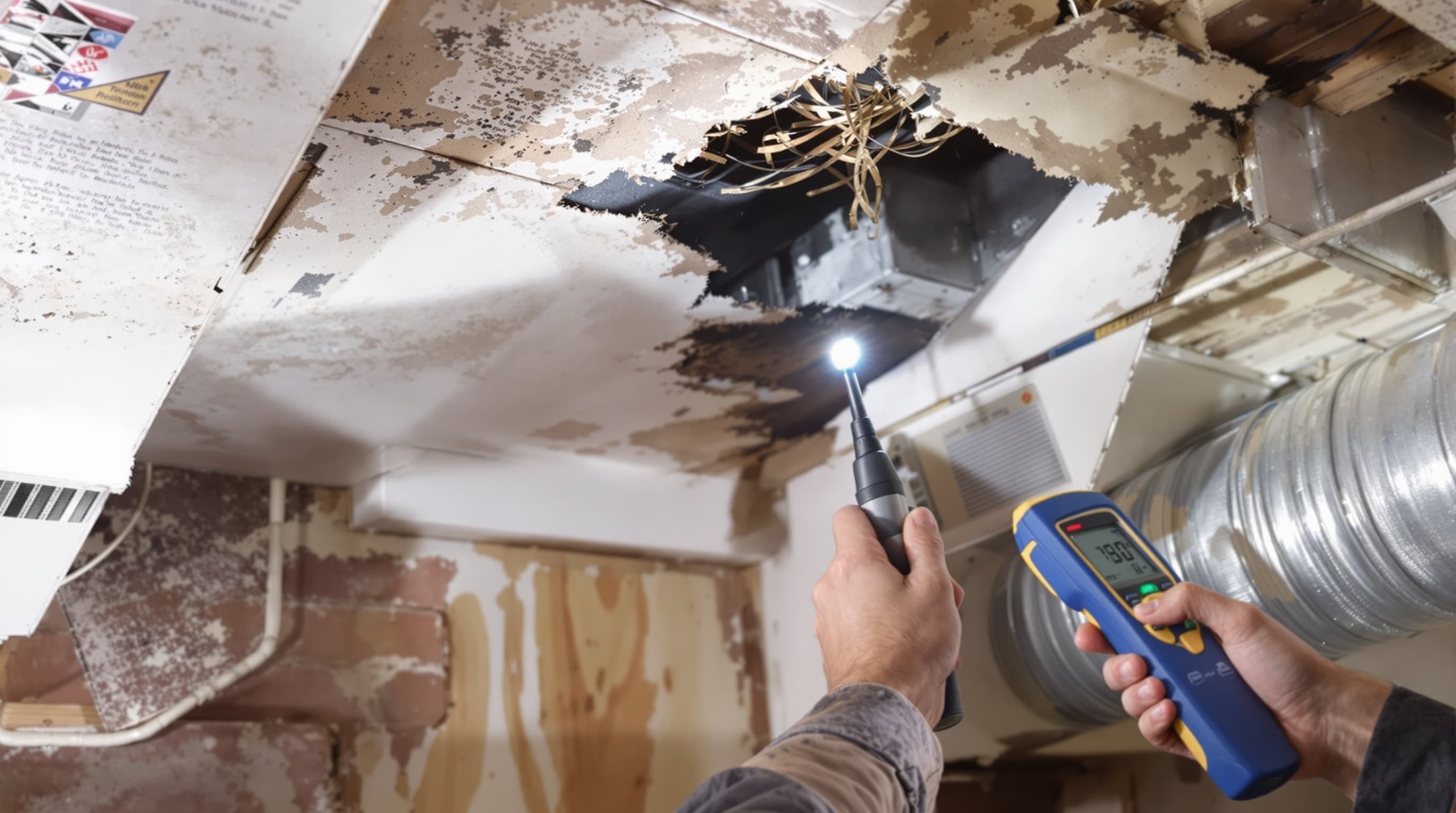
- Moisture mapping — meters on suspect wall/ceiling surfaces
- Thermal imaging for hidden cold-condensation and moisture migration
- Affected sqft measurement with photo documentation
- Written assessment report with an IICRC-S520-aligned remediation work plan
- Recommended clearance criteria (what the post-remediation verification must confirm)
What a remediator does (and doesn't)
The remediator executes the written scope: containment, HEPA-filtered negative air, antimicrobial treatment, affected-material removal, HEPA sanding of framing, encapsulation if applicable, then handoff to the post-remediation verification (PRV) step. Critically, the remediator does not re-scope the job or decide to expand work without a written change order signed by the assessor or the homeowner.
Post-remediation verification (PRV)
PRV is the independent clearance test — air sampling, surface swabs, visual verification — that confirms remediation worked. Under Article 32 best practice, the PRV is performed by a licensed assessor (again, not the remediator). On jobs where the PRV comes from a lab-independent third party, the documentation is stronger for insurance purposes and for any future home-sale disclosure.
What to ask before hiring
- What's your NYLMB license number? (MA for assessor, MR for remediator)
- Will you be writing the assessment AND doing the remediation? (If yes on the same job — red flag.)
- Who's your PRV inspector, and are they independent of your remediation crew?
- Can I see the IICRC S520 protocol you'll follow on my job?
- Do you carry pollution liability insurance? (Not just general liability.)
The bottom line
Article 32 exists because mold remediation is the home-services category most prone to inflated scoping. The law forces a check on every job over 10 sqft. If a contractor pitches you on handling both the inspection and the remediation on the same property, either they're working under a small-job exemption or they're operating out of compliance. Ask for license numbers. Ask for the assessor's report in writing. Any legitimate LI mold company will have both ready before signing anything.
Need help with your specific situation?
We do free on-site assessments across Long Island.
NYLMB-licensed, IICRC-certified, insurance-experienced. Call (631) 625-8807 or request an estimate online.